We are living in the age of the information revolution where we come across information everyday in different forms. Statistics helps us understand and analyze this information. We formally call this information as data which can be obtained from different sources to be interpreted differently. To understand various types of information around us, it’s very important to understand the basics of biostatistics. In a series of blogs we will highlight different parts of statistics which we use in research and connect such concepts with real life examples!
Like every field of learning, statistics also has its own vocabulary. Understanding these basic terms will help you get accustomed with a new science. Let’s start with basic terminologies.

Data
The raw material of statistics is called data. There are various definitions of data. Some statisticians define it as just numbers.
“The quantities, characters, or symbols on which operations are performed by a computer, which may be stored and transmitted in the form of electrical signals and recorded on magnetic, optical, or mechanical recording media”.
Data are characteristics or information, usually numerical, that are collected through observation.
To obtain data we need measurements. In our daily practice we either do this by simple observations or measuring specific characteristics of patients. For Example, When a PT measures ROM of a patient who comes with complaints of shoulder pain, or we measure pain on a scale. The data can also be obtained as whether the patient was satisfied with the services offered or what are the difficulties he faced because of his pain. Therefore, output of our measurement can be in different forms and can be interpreted differently.
Statistics
It is a field of study concerned with collection, organization, summation and analysis of data and the drawing of inferences about a body of data when only a part of the data is observed.
Biostatistics
The tool of statistics when employed in biological sciences and medicine, then we use the term “biostatistics”.
Variables
We can define a variable as anything which varies or can take up a certain value. If we are observing a characteristic, we observe that it can take on different values in different persons, places or things, this characteristic is referred to as a variable. Some examples of variables can be range of motion, blood pressure, muscle performance, age and height of patients.
Types of variables
We broadly divide variables into quantitative variables and qualitative variables. The basic difference between the two is type of data.
Quantitative Variable
It is a variable that can be measured in the usual sense. For example, the height of our patients, their ranges, or body temperature.
Qualitative Variable
It is a variable that cannot be measured in the context of mathematical operation or in other sense information which only can be categorized. For example, patient satisfaction, ethnicity of patient, and diagnosis of a patient.
Population
It is defined as the largest collection of entities for which we have an interest at a particular time. The population can be finite or infinite. We usually describe population as target population
Sample
Sample is usually a part of the population. A sample is a subgroup of the group of interest. Sampling is the procedure by which a sample of units or elements is selected from a population.
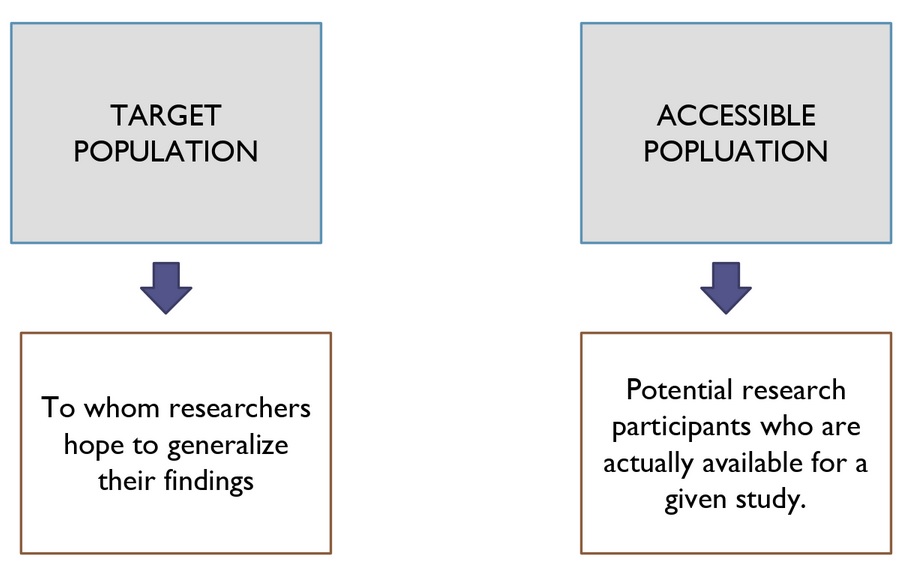
It is important to understand the difference between the sample and population.We should clearly define the population at the start of our study. Usually while conducting any research we define populations in two terms; the target population and the accessible population. The target population is the group where researchers hope to generalize their findings. The accessible population is the group of potential research participants who are actually available for a given study.
So let’s try to understand data in a better way! This will help us in applying more research into practice.
“Most people use statistics like a drunk man uses a lamppost; more for support than illumination”
Andrew Lang


 Research in Motion
Leave a reply to Uma Cancel reply