Social media has changed how physiotherapists learn, communicate, and think about their practice. That is not a bad thing in itself. But a pattern has emerged that is worth taking seriously: the way clinical reasoning gets presented online is increasingly disconnected from how it actually works in a clinic.
Techniques get labelled as evidence-based or debunked. Approaches are championed or dismissed. The posts are short, the tone is confident, and the message is almost always binary. Clinical practice almost never is binary — and when we absorb that binary framing without questioning it, we are not just simplifying our thinking. We are quietly distorting it.
Much of what circulates online frames clinical practice in binaries: this works, that doesn’t; this is evidence-based, that is outdated; this exercise is correct, that one is harmful. While such clarity is appealing, it risks misrepresenting the true nature of clinical practice. Physiotherapy, particularly in musculoskeletal care, rarely operates in absolutes. It exists in a space that is inherently uncertain, context-dependent, and shaped by multiple interacting factors.
The evidence itself does not support a black-and-white view!
What the Posts on Instagram and Twitter Actually Look Like
In 2023, Wageck and colleagues published one of the most detailed analyses to date of how physical therapy is represented on social media. They systematically reviewed 632 posts on Instagram and Twitter that discussed physiotherapy interventions, and what they found should give every clinician pause.
Only 14% of physiotherapy posts on Instagram and Twitter cited any source of information
Of 632 posts analysed, 57% showed potential conflicts of interest, which suggests that the account posting the content had a financial or promotional stake in the intervention being presented. Only 9% of posts were structured in a way that genuinely aimed to facilitate knowledge acquisition. Most posts did not cite references, and of the minority that did, 39% cited sources of poor methodological quality.
Read that again: the overwhelming majority of physiotherapy content circulating on social media carries no cited evidence, is produced by accounts with potential commercial conflicts, and is not designed to help clinicians understand anything more deeply. It is designed to be seen.
This matters because other online media, like webpages or YouTube, are also not credible. Several studies report that the most popular YouTube videos on low back pain or online content related to back pain are not in line with relevant clinical guidelines. Low back pain, being the single most common musculoskeletal complaint in clinical practice, is being misrepresented, showing only a part of the problem.
How Students Are Actually Learning — And What They Trust
A reasonable response might be: this is a content problem, not a consumption problem. Clinicians are trained to be critical. They know how to evaluate sources. They won’t just take Instagram posts at face value.
A 2025 study by Wilczyński and colleagues tested exactly this assumption, and the results are uncomfortable.
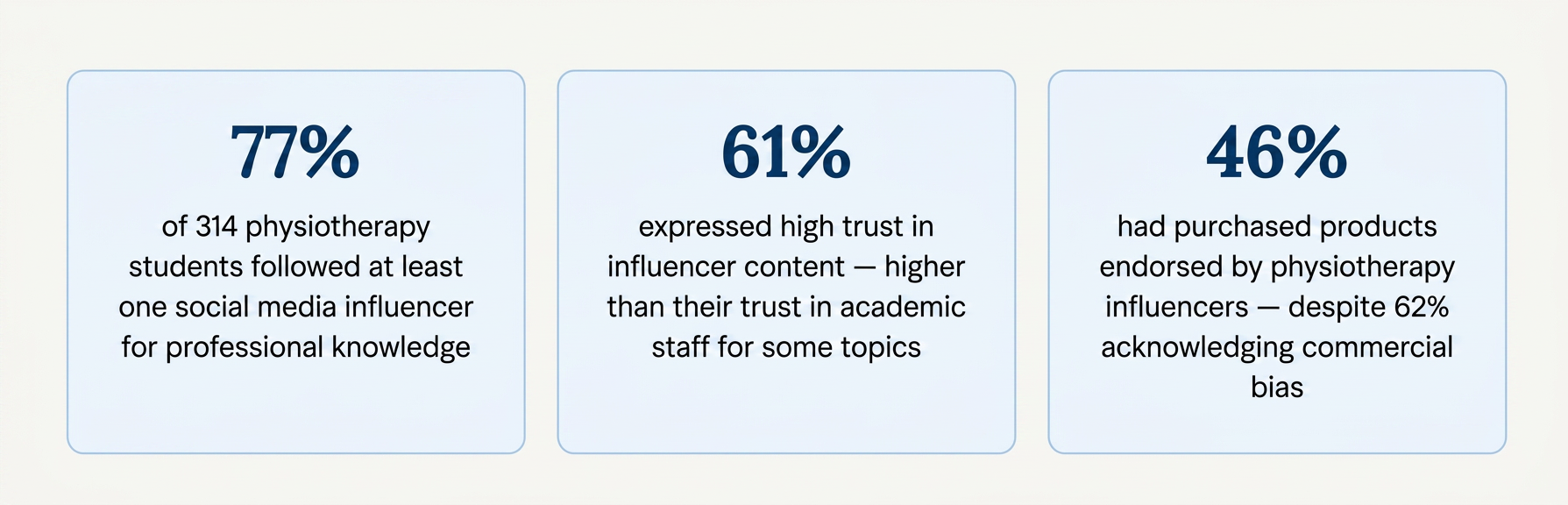
The cognitive dissonance here is striking. Nearly two-thirds of students could identify that influencers had commercial motivations, and this recognition did not reduce their trust or change their behaviour. Students continued to engage with and act on content they had already identified as potentially biased.
More significant still: when the researchers ran an ordinal logistic regression to identify what actually predicted trust in influencers, prior critical appraisal training was not a significant predictor (OR = 1.08, p = 0.45). The skills that physiotherapy education teaches students to use when evaluating evidence were simply not being applied to influencer content. What did predict trust, by a large margin, was frequent information-seeking from influencers themselves (OR = 3.54), meaning the more students used influencers as a source, the more they trusted them.
THE CORE PROBLEM: Trust in social media influencers is built through repeated exposure and perceived informativeness, not through evidence quality. A student who follows five physiotherapy influencers is significantly more likely to trust their content than one who has completed critical appraisal training. The platform builds the trust that the curriculum cannot undo.
Even Those Who Know Better Struggle to Apply It
What about the transition from student to practising clinician? Does critical thinking develop with experience? A 2023 qualitative study by Ma and colleagues directly explored this question, interviewing 16 new graduate physiotherapists transitioning to professional practice about their use of social media for learning [2].
The graduates described social media as a useful and practical learning tool, a way to stay current, find clinical ideas quickly, and engage with content they could not access through academic channels. But they also described significant uncertainty about information credibility, and several participants noted that applying social media content in practice felt “rarely appropriate” once they were in a clinical context. One participant put it plainly: social media should be covered in physiotherapy undergraduate education, because the misinformation is significant, even if the good content is real too.
There is something important in that tension. Social media can expose clinicians to ideas. It cannot equip them with the reasoning to evaluate those ideas well. And the study found that neither student training nor clinical experience was closing that gap reliably.
The Debate on X — Genuine Value, Real Limits
To be fair, not all social media engagement in physiotherapy is passive consumption of influencer content. Alasfour and colleagues (2025) studied how physiotherapists in Saudi Arabia used the professional debate culture on X (formerly Twitter), and the findings are more nuanced.
Professional debates on X enhanced critical thinking, but rarely changed clinical practice directly
Of 188 licensed physiotherapists surveyed, 76.1% were active users of X. Among active users, 69.2% reported that debates had positively impacted their perspectives or approach to physiotherapy, and 62.3% reported gaining knowledge of research findings. However, the direct application of online content to clinical practice was considerably less common. Physiotherapists frequently used X for professional development but were cautious about translating what they found there directly into patient management.
This is where the distinction matters most. A structured professional debate on X, where ideas are challenged, sources are cited, and disagreement is substantive, is a different environment from an Instagram reel promoting a treatment technique. Both are “social media.” They are not equivalent in how they shape clinical reasoning, or how reliably that reasoning holds up when the patient in front of you does not fit the framing of the post.
Why This Matters: Clinical Practice Is Not Black and White
The deeper issue beneath all of this is what social media does to clinical reasoning when it becomes a dominant source of learning. The format rewards certainty. Nuance does not travel well in a caption. And so the version of physiotherapy knowledge that performs best online is the version that is most confident, most decisive, and most binary, which is precisely the version that is least useful at the bedside.
The evidence on almost every musculoskeletal condition tells the same story: different patients respond differently to the same intervention. Treatment effects are probabilistic, not deterministic. Nothing works for everyone. This is not a gap in the research; in many cases, it is what the research is telling us. The grey zone is not where knowledge runs out. It is where honest clinical reasoning actually lives.
Real evidence-based practice, as Sackett defined it nearly thirty years ago, is not just about finding a good study. It is about integrating three things simultaneously
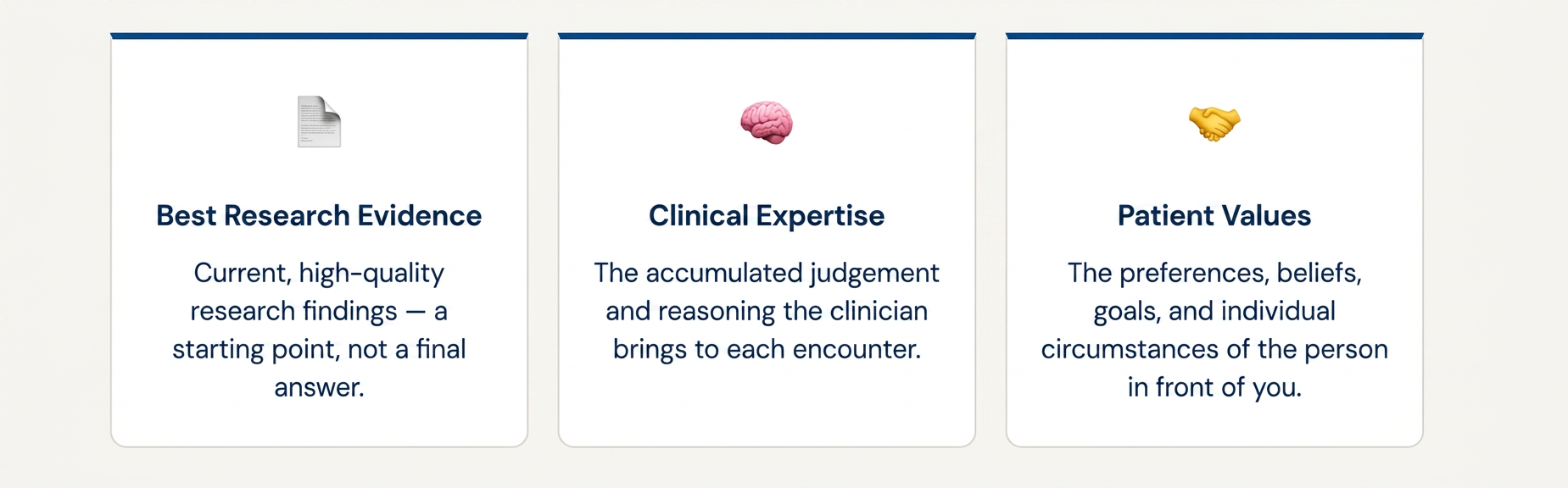
Social media collapses this model into a distorted version of reasoning, since the evidence being shared is frequently uncited, commercially motivated, or selectively presented. The result is a generation of clinicians who may know a great deal about what is currently trending in physiotherapy online, but who have had fewer opportunities to develop the slower, less visible skills of genuine clinical reasoning.
What Should We Do About It?
The answer is not to stop engaging with social media. The Alasfour et al. findings show that structured professional engagement online can genuinely support critical thinking and knowledge currency. The studies do suggest that graduates found real value in social media as an adjunct learning tool. The problem is not the platform, but it is the absence of a framework for using it well.
A MORE USEFUL APPROACH is to treat social media content the way you would treat a conference presentation: potentially informative, worth listening to, but not a substitute for reading the primary research, applying clinical judgement, and checking what the patient actually wants. The post is a prompt for thinking, not a conclusion.
The Wilczyński et al. authors are direct about what needs to change in education: standard critical appraisal training is not enough, because it is not being applied to influencer content in practice. What might help is training that engages specifically with the formats students actually consume.
For those of us already in practice, the ask is simpler: hold the confidence of social media content loosely. The posts that perform best are usually the ones that have resolved the complexity first, which is exactly what clinical reasoning cannot afford to do.
Another way forward is not to disengage from social media, but to engage with it more responsibly. If more healthcare professionals contribute to this space, sharing content that is grounded in evidence, transparent in its limitations, and sensitive to patient context, the overall quality of information can improve. In doing so, clinicians and students alike may begin to rely less on popularity and more on credibility when navigating online content. Social media, despite its limitations, remains a powerful medium. The issue is not its existence, but how it is used. When content is created with a commitment to ethical practice, intellectual honesty, and compassion for patients, it can move beyond simplification and become a meaningful extension of clinical education and professional responsibility.
I hope this sparks some meaningful discussion, particularly around how we interpret evidence and how social media is shaping the way we think and practice.
References
- Wageck B, Noal IS, Guterres BD, Adami SL, Bordin D, Fanfa M, Nunes GS. Keep posting and following social media profiles about physical therapy, but be aware! A cross-sectional study of social media posts on Instagram and Twitter. Braz J Phys Ther. 2023;27(1):100484. doi:10.1016/j.bjpt.2023.100484. PMCID: PMC9995938.
- Wilczyński B, Antczak H, de Tillier K, Taraszkiewicz M, Sobczak K, Zorena K, et al. Physiotherapy students’ trust in social-media physiotherapy influencers: implications for digital-literacy training in medical education. BMC Med Educ. 2025;25:1215. doi:10.1186/s12909-025-07760-0. PMCID: PMC12392578.
- Ma TW, Leung L, Martin R, Mandrusiak A, Forbes R. “A great tool to open your eyes”: new graduate physiotherapists’ perceptions and use of social media for learning. Physiother Theory Pract. 2024;40(9):2038–2050. doi:10.1080/09593985.2023.2231539. PMID: 37395153.
- Alasfour M, Lajami Z, Algashami A. Perceived impact of physiotherapy-related debates on the social platform “X” on physiotherapists’ professional development and knowledge acquisition: a cross-sectional study. BMC Med Educ. 2025;25:155. doi:10.1186/s12909-025-06760-4. PMCID: PMC11780977.
- Sackett DL, Rosenberg WMC, Gray JAM, Haynes RB, Richardson WS. Evidence-based medicine: what it is and what it isn’t. BMJ. 1996;312:71–72. doi:10.1136/bmj.312.7023.71.
- Suhail, A., & Quais, S. (2022). Content analysis of the online information available about back pain. Bulletin of Faculty of Physical Therapy, 27, Article 23. https://doi.org/10.1186/s43161-022-00075-4
- Kara, M., Ozduran, E., Kara, M. M., Hanci, V., & Erkin, Y. (2024). Assessing the quality and reliability of YouTube videos as a source of information on inflammatory back pain. PeerJ, 12, e17345. https://doi.org/10.7717/peerj.17345
- Powell, J. K., McDevitt, A., & Cook, C. (2026). Many paths to recovery: The case for treatment pluralism. Journal of Orthopaedic & Sports Physical Therapy. Advance online publication. https://doi.org/10.2519/jospt.2026.13992


Leave a Reply