Physiotherapy education has long grappled with a fundamental question: how do we ensure that graduates are not merely knowledgeable, but genuinely capable of delivering safe, effective, and patient-centred care? Increasingly, the answer lies in a shift from traditional, time-based training models to competency-based education (CBE). This approach places demonstrated ability at the heart of professional preparation.
This post, the first in a series exploring contemporary approaches to physiotherapy education, introduces the concept of competence and examines how it is understood and applied within the physiotherapy profession, drawing on the Physiotherapist Education Framework published by World Physiotherapy (2021).
What Is Competence?
The term “competence” is frequently used in healthcare education, yet its meaning is not always precisely defined. The World Physiotherapy framework addresses this directly, acknowledging that there are “conceptual and terminological inconsistencies in the literature when defining competence.” For the purposes of professional education and practice, competence is defined as “the proven ability to use knowledge, skills, and personal, social and methodological abilities, in practice or study situations and in professional and personal development.”
This definition is important for several reasons. First, it moves beyond the mere possession of knowledge. A physiotherapist may understand the anatomy of the shoulder joint in considerable detail, yet this alone does not make them competent to assess or treat a patient presenting with shoulder pathology. Competence requires the integration of knowledge with practical skills, professional values, and sound clinical judgement — all applied within the complexity of real-world situations.
Second, competence is understood as dynamic and contextual. The level of competence any individual physiotherapist brings to a given situation is influenced by their qualifications, clinical experience, professional development, and capacity to integrate these dimensions of practice. This means competence is not a fixed state achieved at graduation; it must be actively maintained and developed throughout a professional career.
Competence and the Eight Domains of Physiotherapist Practice
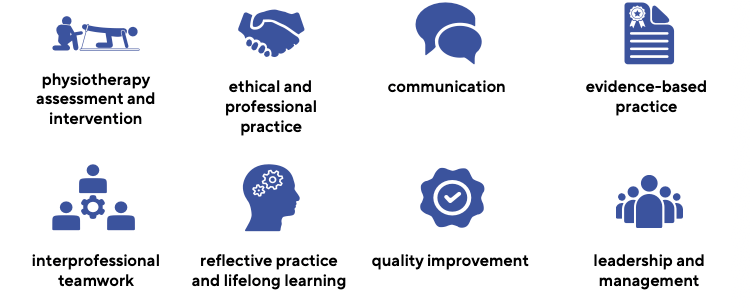
The World Physiotherapy framework organises physiotherapist competence into eight distinct domains, each representing a core area of professional practice:
- Physiotherapy assessment and intervention — the clinical foundation of practice, encompassing client assessment, diagnosis, goal-setting, intervention, and discharge planning.
- Ethical and professional practice — the application of professional standards, legal obligations, and person-centred values.
- Communication — the ability to communicate clearly, empathically, and effectively across a range of contexts and with diverse populations.
- Evidence-based practice — the critical appraisal and application of research evidence to inform clinical decision-making.
- Interprofessional teamwork — collaborative working within multidisciplinary teams to optimise patient outcomes.
- Reflective practice and lifelong learning — the ongoing evaluation of one’s own performance and commitment to continuous professional development.
- Quality improvement — participation in service monitoring, data analysis, and improvement initiatives.
- Leadership and management — the capacity to lead effectively, manage complexity, and contribute to organisational and policy development.
Each domain is not simply a topic area to be taught; it is defined by a set of observable activities that a competent physiotherapist must be able to perform to a defined standard. This is a hallmark of competency-based thinking — the shift in emphasis from what a student has been taught to what a graduate can do.
What Is Competency-Based Education?
Competency-based education is an approach to curriculum design and delivery in which learning outcomes, teaching methods, and assessments are all structured around the attainment of clearly defined competencies. Rather than progressing through a programme by virtue of time spent, students advance by demonstrating that they have met specified performance standards.
In physiotherapy, this approach carries significant implications. Entry-level education programmes must be designed with the end in mind — preparing graduates who are competent to practise safely and effectively upon completion of their studies. The World Physiotherapy framework refers to an entry to practice threshold: a point on the continuum of professional development that represents the minimum acceptable level of competence to enter the profession. This threshold is not a ceiling, but a starting point — the foundation from which ongoing professional development continues across a career.
Competency-based education, therefore, demands alignment between what graduates are expected to be able to do, the learning opportunities provided to develop those abilities, and the assessment methods used to verify that competence has been achieved. These three elements: outcomes, learning, and assessment must work together coherently if an education programme is to be genuinely competency-based.
From Content Delivery to Outcome Orientation
Traditional educational models in physiotherapy have largely been content-driven. Curricula are organised around subjects (anatomy, physiology, pathology), and progression is often time-based. While this structure ensures coverage of foundational knowledge, it does not necessarily guarantee that graduates are prepared for the complexities of practice.
Competency-based education represents a paradigm shift. The focus moves from:
- What is taught → to what is demonstrated
- Time spent learning → to the ability achieved
- Knowledge acquisition → to application in practice
In this model, the starting point is not the syllabus, but the expected capabilities of a graduate physiotherapist. Educational design then works backwards to align:
- Curriculum content
- Teaching and learning strategies
- Assessment methods
This alignment ensures that all aspects of the educational process contribute to the development of clearly defined competencies.
Why Does This Matter for Physiotherapy?
Physiotherapy is a profession defined by complexity. Physiotherapists practise as autonomous, independent practitioners across diverse settings — from acute hospital wards to community clinics, schools, sports facilities, and increasingly, digital environments. They work with clients whose needs span physical, psychological, and social dimensions, within healthcare systems shaped by local policy, resource constraints, and cultural context.
This complexity demands more than technical proficiency. It demands professionals who can reason critically, adapt to uncertainty, collaborate interprofessionally, reflect meaningfully on their own practice, and commit to lifelong learning. Competency-based education, when implemented thoughtfully, provides the framework within which these broader capabilities can be developed and assessed with rigour and intention.
The World Physiotherapy framework is explicit on this point: physiotherapy education is not merely the transmission of knowledge, but “the integration of theory, evidence, and experiential practice that continues throughout professional life.”Competency-based education provides the structure to make that integration purposeful.
Looking Ahead
This post has introduced the foundational concepts of competence and competency-based education as understood within the physiotherapy profession. In subsequent posts, we will examine how these principles translate into curriculum design, teaching and learning approaches, assessment strategies, and continuing professional development, exploring both the opportunities and the challenges that competency-based frameworks present for educators and practitioners alike.
Reference: World Physiotherapy. Physiotherapist education framework. London, UK: World Physiotherapy; 2021.


Leave a Reply